.jpg)
Every late November through January, more than half of all workplace pick'em entries collapse for the exact same reason: players keep backing big-name favorites based on October standings while ignoring travel fatigue, rotation rests, and cold-weather scoring drops. In a 16-week NFL pool or a 2026–27 NBA Cup bracket, flipping just two or three trap games a week separates top-10% finishers from the middle of the pack.
Instead of guessing off highlight clips, here is the exact four-metric framework sharp sports analysts use across the NBA, NFL, college football, English Football League (EFL), NHL, eSports, and table tennis—plus how international fans verify trustworthy online platforms during peak tournament season.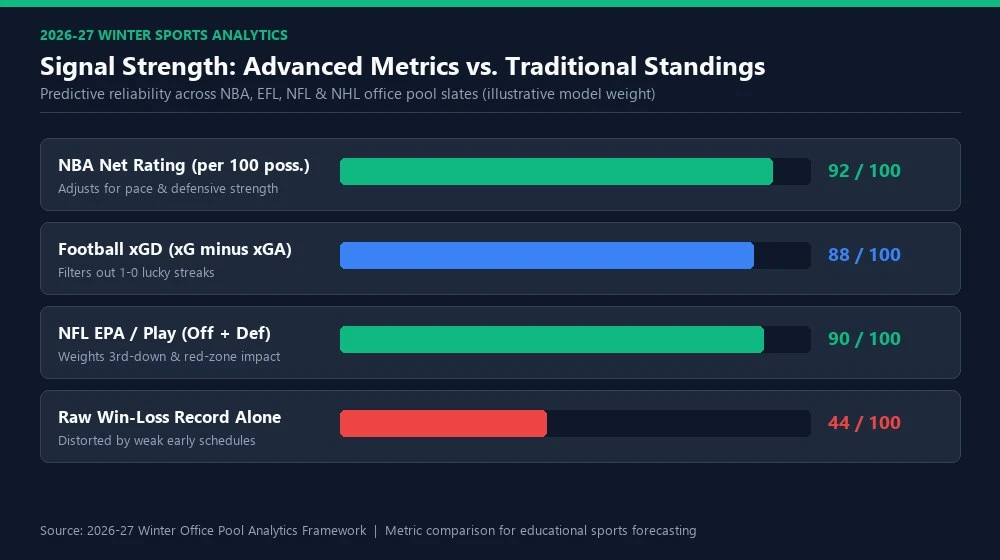
1. Four Metrics That Beat Raw Win-Loss Standings Every Winter
Early-season records lie. A basketball team averaging 121 points per game can still be a below-average squad if it plays at the league's fastest pace and gives up 123 points. Likewise, an EFL club riding three straight 1–0 wins may simply be surviving on unsustainable goalkeeper heroics. Track these four numbers instead:
|
League / Sport |
Metric to Track |
What Raw Standings Hide |
Pool Decision Trigger |
|---|---|---|---|
|
NBA (2026–27) |
Net Rating (per 100 poss.) |
High-pace weak defenses inflating PPG |
Fade road teams on 2nd night of back-to-back if Net Rating < +2.0 |
|
EFL / Premier League |
Expected Goal Diff (xGD) |
Lucky 1–0 streaks against poor finishing |
Look for upsets when a favorite has negative xGD over last 5 matches |
|
NFL & College Football |
EPA per Play (Off + Def) |
Empty garbage-time passing yards |
Back higher rush-EPA underdogs when stadium winds exceed 15 mph |
|
NHL / eSports / WTT |
GSAx, Patch Win%, H2H |
Hot goalies or outdated world rankings |
Prioritize recent patch map-pool depth and deciding-set win rates |
2. Worked Example: Spotting a Classic December Trap Game in 30 Seconds
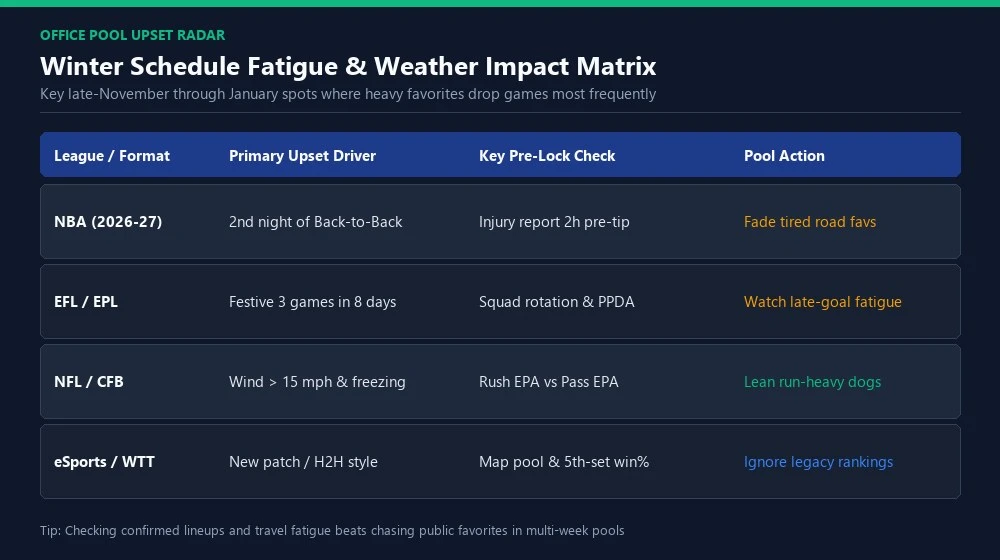
Imagine an NBA road favorite sitting at 14–6 visiting a 10–10 home underdog on a Friday night. Eighty percent of your office pool checks the 14–6 record and clicks the favorite without blinking. Now look under the hood: the favorite played an overtime game 22 hours earlier in another time zone, its starting point guard is listed questionable for rest, and its bench unit ranks 24th in Net Rating (-4.8). Meanwhile, the home underdog has had two full days of rest and owns a +3.1 home Net Rating. That single 30-second check turns a blind crowd pick into a high-leverage contrarian win.
The exact same principle applies across late-November and December NFL and college football slates. When a dome-stadium passing offense travels outdoors into 25-degree air with sustained 18-mph crosswinds, deep-ball completion rates routinely drop by 10 to 15 percentage points. Pool players who blindly trust season-long passing yards get burned, while analysts who compare rushing EPA per play and red-zone defensive efficiency spot the cold-weather upset days before kickoff.
In English Football League (EFL) and Premier League festive fixtures, the hidden edge sits in squad depth. When clubs play three competitive matches in eight days, high-pressing sides with shallow benches lose sprinting intensity after the 65th minute. Checking a club's rolling five-match Expected Goal Difference (xGD) alongside its bench minutes quickly exposes overperforming favorites ready to drop points on the road—just as tracking patch adaptation rates and deciding-set win percentages separates sharp picks from casual guesses in year-end eSports majors and international ping pong tournaments.
3. Three Psychological Traps That Quietly Sink Brackets
- Recency Bias: Overweighting a primetime blowout win while ignoring that the opponent played without two starters or shot an anomalous 18% from three-point range.
- Loyalty Blind Spots: Letting personal team fandom override confirmed injury lists or brutal five-games-in-seven-nights travel legs.
- Forced Contrarian Picks Too Early: Picking low-probability underdogs just to be different in Week 6 burns points. Save contrarian leans for genuine fatigue or weather mismatches.
4. Digital Safety for Global Sports Fans Researching Online Platforms
Peak tournament months also bring a wave of spoofed streaming portals, unverified messaging-app tipster groups, and opaque entertainment sites. Across major Asian sports hubs like Hong Kong—where mobile viewing and instant digital payments are part of everyday life—experienced fans apply three quick verification habits before trusting any unfamiliar platform:
- Check Independent Audit Benchmarks First: Instead of clicking random short links on social media, Cantonese-speaking readers researching local Hong Kong cashnet (香港現金網) platforms review objective transparency records, payout track histories, and safety checklists before registering anywhere.
- Screen Payment Details and Skip Unsigned Downloads: Never install unverified mobile APK files promoted outside official app stores, and never wire upfront "verification" or "unlock" fees to personal bank accounts. Checking recipient IDs against official anti-fraud tools before sending instant transfers prevents avoidable losses.
- Keep Pools Strictly Recreational: Whether running a workplace bracket, a fantasy roster, or weekend picks, set a fixed entertainment budget and stick to it regardless of short-term streaks.
Quick FAQ: Winter Office Pool Strategy
When is the best time to lock in NBA and NFL pool picks?
Always wait until 60 to 90 minutes before kickoff or tip-off whenever pool rules allow. Late NBA rest announcements and NFL cold-weather wind updates routinely shift true win probability by 8% to 15%.
Why does Expected Goal Difference (xGD) matter more in December EFL fixtures?
During festive fixture congestion (three matches in eight days), squads with thin benches lose pressing intensity late in matches. Negative xGD flags teams whose lucky results are about to break.
How can I stand out in a large 100-person office pool?
Stay disciplined on clear statistical mismatches and target 2 to 3 fatigue-driven home underdogs per week rather than blindly guessing longshots across the entire slate.