
Soccer has a special way of bringing people together. A last-minute winner, an unexpected upset, or a dramatic comeback can turn an ordinary weekend into something memorable. But watching matches becomes even more exciting when everyone has made their predictions. With a little preparation, you can organize a soccer pool that keeps friends, family members, or coworkers engaged throughout the season.
The best part? You don't need to be a soccer expert to participate. A basic understanding of the fixtures and a little competitive spirit are enough to get started. Resources such as matchxi.com make it easier to follow Premier League fixtures, team lineups, results, and standings while preparing weekly predictions.
Whether you're organizing a small office competition or a season-long challenge with friends, here's how to create a soccer pool that people will genuinely enjoy.
What Is a Soccer Pool?
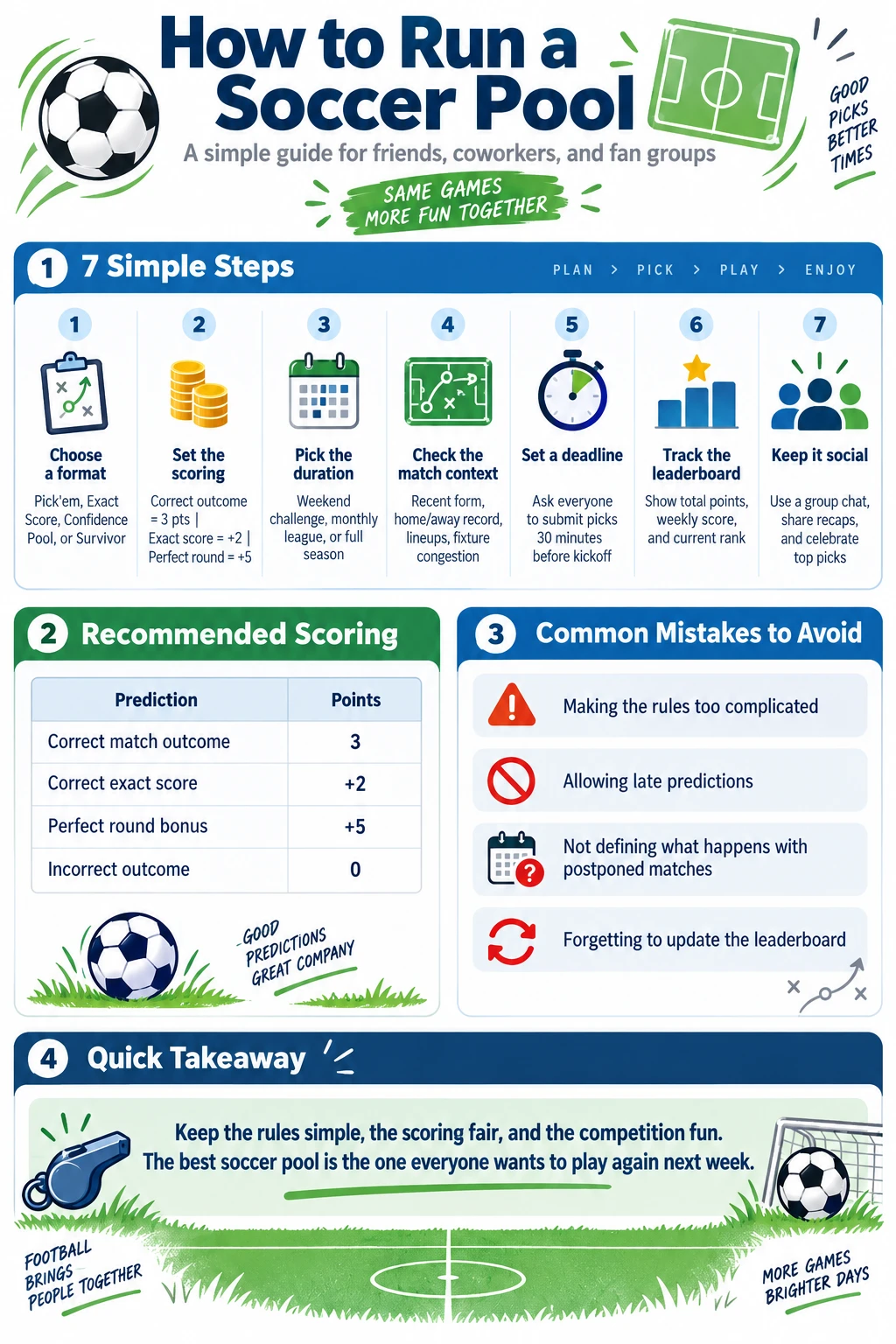
A soccer pool is a prediction competition in which participants try to forecast the outcomes of upcoming matches. Players earn points for correct predictions, and the person with the highest score wins the competition.
Unlike traditional fantasy soccer, where participants manage virtual squads, a prediction pool focuses on actual match results.
Depending on the format, participants might predict:
-
Which team will win a particular match.
-
Whether a game will end in a draw.
-
The exact final score.
-
Which team will finish highest in the standings.
-
Which clubs will qualify for European competitions.
You can organize a pool around a single matchday, an international tournament, or an entire domestic season.
For beginners, the English Premier League is a particularly entertaining option because it offers regular fixtures, familiar clubs, and plenty of surprising results.
Step 1: Choose the Right Soccer Pool Format
Before inviting participants, decide how the competition will work.
Different formats suit different groups. Some reward consistent predictions, while others encourage bold decisions.
|
Pool Format |
How It Works |
Best For |
|---|---|---|
|
Pick'em Pool |
Predict the winner or draw for each match |
Beginners and office groups |
|
Exact Score Pool |
Predict the final score of each game |
Experienced soccer fans |
|
Confidence Pool |
Rank predictions by confidence, earning more points for stronger picks |
Competitive groups |
|
Survivor Pool |
Pick one team to win each round, following elimination rules |
Fans who enjoy high stakes |
|
Tournament Pool |
Predict which teams will advance through knockout rounds |
World Cup and cup competitions |
For most first-time organizers, a simple Pick'em Pool is the easiest choice.
It requires minimal explanation and gives everyone a reasonable chance of competing, even if they don't follow soccer closely.
Step 2: Establish Clear Scoring Rules
A successful soccer pool needs one thing above all else: rules everyone understands.
Nobody wants to discover halfway through the competition that a correct prediction counts differently than expected.
For a Premier League prediction pool, you could use the following scoring system:
|
Prediction |
Points Awarded |
|---|---|
|
Correct match outcome (home win, draw, away win) |
3 |
|
Correct exact score |
2 additional |
|
Incorrect match outcome |
0 |
|
Correctly predicted draw |
3 |
|
Perfect prediction of all matches in a round |
5 bonus |
Under this system, someone predicting Arsenal to beat Chelsea 2–1 would receive five points if the result finished exactly that way.
If Arsenal won 3–1 instead, the participant would still earn three points for correctly predicting the winner.
These are suggested rules rather than a universal standard. You can modify the scoring system to suit your group.
"The best soccer pool isn't necessarily the one with the most complicated rules. It's the one where everyone understands how to play and wants to come back next week."
Consider keeping the same scoring system throughout the season. Constant changes can make the competition feel unfair.
Step 3: Decide How Long the Competition Will Last
One of the biggest organizational decisions is choosing the competition's duration.
A full Premier League season provides months of entertainment, but it also requires regular participation.
If you're organizing a pool for coworkers who are unfamiliar with soccer, starting with a four-week challenge might be more practical.
Here are three possible approaches:
Weekend Challenge: Participants predict the results of one round of matches. The highest score wins.
Monthly League: Everyone submits predictions for several consecutive matchweeks, with points accumulated across the month.
Season-Long Championship: Participants compete across the entire league season, with a running leaderboard.
For larger groups, a monthly championship can offer a useful balance between commitment and excitement.
It also allows newcomers to join future competitions without starting dozens of points behind everyone else.
Step 4: Use Fixtures, Lineups, and Team Form
Predicting soccer results involves more than simply choosing the biggest club.
A team that looks unbeatable on paper might struggle after playing several demanding matches in quick succession. Injuries, suspensions, tactical adjustments, and fixture congestion can all influence performance.
Before submitting predictions, encourage participants to consider several factors.
Recent Results
Look beyond a team's league position.
A club sitting seventh might have won four of its last five matches, while a team in third could be struggling for form.
Recent performances can provide useful context, although they don't guarantee future results.
Home and Away Performance
Some teams perform considerably better at home than on the road.
Travel, familiar surroundings, and crowd support can all influence a match.
Check whether a team's recent success has come primarily at its home stadium.
Starting Lineups
A missing goalkeeper, central defender, or leading goalscorer can change the balance of a fixture.
Predicted lineups can help participants prepare, but confirmed starting elevens are generally more useful when available before the prediction deadline.
Fixture Congestion
Clubs competing in domestic leagues and European tournaments sometimes face several matches within a short period.
Rotation and fatigue may affect their performances.
The goal isn't to find a flawless prediction formula. It's to make the competition more interesting by encouraging informed decisions.
Step 5: Set a Weekly Prediction Deadline
Nothing creates unnecessary arguments faster than participants submitting predictions after matches have started.
Establish one clear deadline for every round and communicate it in advance.
For example, everyone might be required to submit predictions 30 minutes before the first selected match kicks off.
You should also decide what happens when someone misses the deadline.
Possible rules include:
-
Awarding zero points for missed predictions.
-
Allowing predictions for matches that haven't started.
-
Using a previously submitted default prediction.
-
Permitting one missed round without a penalty.
Whatever approach you choose, apply it consistently to every participant.
For international groups, include the relevant time zone in deadline announcements.
Step 6: Create a Leaderboard That Keeps Things Interesting
A visible leaderboard transforms a collection of predictions into a proper competition.
People enjoy tracking their progress, comparing results, and seeing whether they're closing the gap on the leader.
An effective leaderboard should show each participant's total points, weekly score, and current ranking.
You can also introduce optional statistics such as prediction accuracy or the number of exact scores predicted.
To keep the competition engaging, consider recognizing achievements beyond the overall winner.
For example, you could award informal titles for the best prediction of the week, the biggest comeback, or the most surprising correct upset.
These extra challenges give participants something to compete for even when they aren't close to first place.
Step 7: Make Participation Social
The most memorable soccer pools aren't always the ones with the largest prizes.
They're the ones that generate conversations.
Create a group chat where participants can discuss matches, share predictions, and celebrate unexpected results.
A dramatic equalizer in stoppage time becomes much more entertaining when it changes the leaderboard for several people.
You can also introduce weekly traditions:
-
Publish a short preview before each matchweek.
-
Highlight the most popular predictions.
-
Share an updated leaderboard after the final match.
-
Celebrate the week's highest-scoring participant.
-
Let participants vote for the most surprising result.
Friendly rivalries help turn casual participants into regular contributors.
Just remember that the atmosphere should remain welcoming. Newcomers should feel comfortable participating even when they're unfamiliar with particular clubs or players.
Common Mistakes to Avoid
Even a simple soccer pool can become frustrating when basic details are overlooked.
One common mistake is making the scoring system too complicated. Too many bonus categories can leave participants confused about how points are calculated.
Another is failing to define how postponed or abandoned matches will be handled.
For a standard league competition, it's sensible to establish whether those games will be excluded from the round or scored after they're eventually completed.
Organizers should also clarify whether predictions are based on the result after 90 minutes plus stoppage time or include extra time and penalties in knockout competitions.
Finally, avoid relying on one person to update every score manually if the group becomes large.
Using an organized pool-management system can make standings and scoring much easier to maintain.
Final Thoughts: Keep It Simple and Enjoy the Competition
A well-organized soccer pool can turn an ordinary football season into a shared experience.
It gives people a reason to follow unfamiliar teams, pay closer attention to fixtures, and celebrate results they might otherwise ignore.
Start with straightforward rules, a manageable schedule, and an easy-to-understand scoring system. Use reliable match information, keep the leaderboard updated, and encourage friendly discussion.
As participants become more comfortable, you can introduce confidence rankings, exact-score bonuses, or special tournament challenges.
Ultimately, the point of a soccer pool isn't to predict every match correctly. It's to enjoy the uncertainty of the game together.
And when an underdog scores a last-minute winner that nobody saw coming? That's usually when the competition gets really interesting.