Clash of Clans looks simple from the outside. You build a base, you train some troops, you attack other people. Spend a few weeks in a competitive clan and you learn how deep it actually runs. The players who win consistently are not the ones with the flashiest armies. They are the ones who plan, coordinate, and manage their time well. This is a strategy game wearing a cartoon coat, and the strategy is where the real fun lives.
Here is how the competitive side of Clash of Clans works, and what separates a clan that wins from one that just shows up.
A Clan Is a Team, Not a Chat Room
A clan is a group of up to 50 players who band together to compete. The good ones treat that like a real team. There is a leader and a set of co-leaders who run things, and every member has a role to play.
The leaders act as organisers. They set expectations, recruit new members, and decide who plays in the big war lineups. Strong clans have a clear culture. Some are casual and social, happy to lose a war and laugh about it. Others are strict and only keep players who pull their weight. Neither is wrong, but the best clans know which one they are and recruit to match.
What holds a clan together is accountability. In a loose group, people drift. They forget to use their attacks, they go quiet, and the team loses wars it should win. In a well run clan, everyone knows their job and does it. That structure is what keeps members coming back, more than any reward the game hands out.
Clan Wars Reward Planning, Not Luck
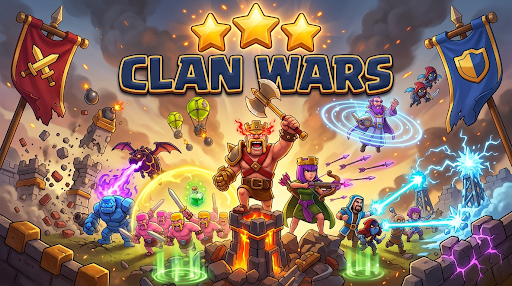
Clan wars are where the strategy gets real. Two clans of equal size face off. Each member gets a limited number of attacks against enemy bases. Every successful attack earns stars, and the clan with the most stars wins the war.
The catch is that attacks are limited. You cannot spam your way to a win. You have to pick your target carefully, match your army to the enemy layout, and coordinate so two people do not waste attacks on the same base. It is closer to a chess match than a brawl.
Smart clans assign targets in advance. Strong attackers take the hardest bases at the top of the map. Newer players get matched to bases they can actually three-star. Nobody is left guessing, and no attacks go to waste. A clan that plans its targets will beat a clan of stronger solo players who all attack whatever looks fun.
There is also the two attack rhythm. Your first attack scouts the base and takes what stars you can. Your second cleans up bases your teammates could not finish. Coordination in that second wave often decides close wars. A team that talks through its cleanup plan wins the tight ones. A team that stays silent leaves stars on the table.
Base Building Is a Long Game
Away from wars, the core of the game is your own base. You upgrade your Town Hall, build defences, train troops, and manage resources. Every upgrade takes time, and the higher levels take a lot of it. This is the part that separates casual players from committed ones.
The strategy here is all about priorities. Do you rush your Town Hall to unlock new content, or upgrade your defences first so you can hold your rank? Rushing gets you to the big leagues fast but leaves you weak, with high level content you are not ready for. Steady building makes you tougher but slower. Most experienced players will tell you balance wins. Push forward, but do not outrun your own defences.
Getting your upgrade order right matters more than people expect. A well built base at a lower Town Hall can beat a rushed base two levels above it. If you care about wars, you build with wars in mind, protecting the defences and heroes that decide close matches.
Resource Management Never Stops
Clash of Clans runs on two things, gold and elixir, and later dark elixir. You earn them by raiding other bases, then spend them before someone raids you back. Sitting on a full bank makes you a target. Every attacker on the map can see there is loot to grab.
The players who climb fastest are the ones who never let progress sit idle. They keep a builder working at all times and spend their resources as fast as they earn them. An idle builder is wasted time, and in a game measured in weeks and months, wasted time adds up. Good resource habits are boring, but they are the difference between a base that grows and one that stalls.
How Do You Get Competitive Faster?
Here is the honest part. Climbing from a fresh base to a war-ready one takes months of steady play. Not everyone has that kind of runway, especially if your friends are already deep into war leagues and you want to play alongside them now rather than next year.
This is why some players skip the slow start. Instead of grinding through the early Town Hall levels alone, they pick up an established base and jump straight to the part of the game they enjoy. If that appeals to you, you can find a clash of clans account for sale with a maxed or near maxed base and drop into serious competition without the long climb. A word of caution though. Account trading sits against the game's terms of service, so anyone going this route is making a personal choice with those risks in mind.
However you get there, the goal is the same. You want to be useful in a war, not the weak link everyone has to carry.
The Payoff
Clash of Clans rewards the same habits that pay off in any competition. Organise your team. Plan your attacks. Build with a purpose. Keep your resources moving. None of it is complicated, but doing all of it consistently is what wins wars.
The players who treat it as a real strategy game, not just a base to poke at between meetings, are the ones who end up on top of the leaderboard. Pick your clan, learn the maps, coordinate your attacks, and the game opens up in a way casual players never see.

.jpg)